- 0
- 1,822 word
Picture stepping into a gallery where words float off the page, voices overlap in Korean, English, and French, and a single gesture can feel like an entire history unfolding. That’s the quiet power of Theresa Hak Kyung Cha’s art. Right now, the Berkeley Art Museum and Pacific Film Archive (BAMPFA) is hosting Theresa Hak Kyung Cha: Multiple Offerings, the first major retrospective of her work in twenty-five years. Running from January 24 to April 19, 2026, this show gathers over one hundred pieces—many never displayed before—and lets her many voices speak at once.
I first stumbled across Cha’s work years ago in a used bookstore, flipping through a worn copy of Dictée. It felt like someone had handed me a puzzle with no edges. The pages mixed memoir, myth, and history in ways that left me both unsettled and hooked. Seeing this retrospective now, I realize how much more there was to her practice. It’s not just one book—it’s a lifetime of experiments that still feel urgent today.
Who Was Theresa Hak Kyung Cha?
Theresa Hak Kyung Cha was a Korean-American artist, writer, and filmmaker whose brief career packed more innovation than many lifetimes. Born in 1951 in Busan, South Korea, during the Korean War era, she moved with her family to the United States around age twelve, first to Hawaii and then the Bay Area. Her life bridged cultures, languages, and traumas, shaping art that refuses easy categories.
Her Early Life and the Weight of Displacement
Growing up amid the echoes of Japanese colonial rule and the Korean War’s aftermath, Cha carried a deep sense of rupture from the start. Her family’s emigration wasn’t just a move—it was a severance from language, home, and history. That early fracture became the quiet engine behind everything she made, turning personal loss into universal questions about belonging.
Education and the Spark at UC Berkeley
At UC Berkeley, Cha earned four degrees while soaking up the 1970s conceptual art scene. She worked as an usher in the theater and an art handler at the very museum now hosting her show. Those campus years weren’t just study—they were where she started weaving fibers, shaping clay, and staging performances that tested the limits of what art could say.
The Iconic Dictée and Its Lasting Power
Dictée, published in 1982 just days before her death, remains her best-known work. This genre-defying book collages memoir, Korean history, Greek mythology, and Catholic ritual into something that feels alive and unfinished. It doesn’t explain—it invites you to piece together the fragments yourself, much like the immigrant experience itself.
Why Dictée Still Resonates Decades Later
Readers keep returning to Dictée because it refuses to tidy up pain. Instead of a neat narrative, it offers layers: stutters, silences, and overlapping voices. In an era of polished memoirs and quick identity takes, Cha’s approach feels radical and honest. It’s no wonder artists and writers still cite it as a touchstone for exploring diaspora.
Beyond Dictée: Cha’s Full Artistic Range
The retrospective shines by decentering Dictée and showing the breadth of her output. From early student ceramics to mail art and video loops, Cha treated every medium as a way to probe language’s failures and possibilities. Her practice was playful yet precise, meditative yet disruptive.
Performance Art That Engaged the Body Directly
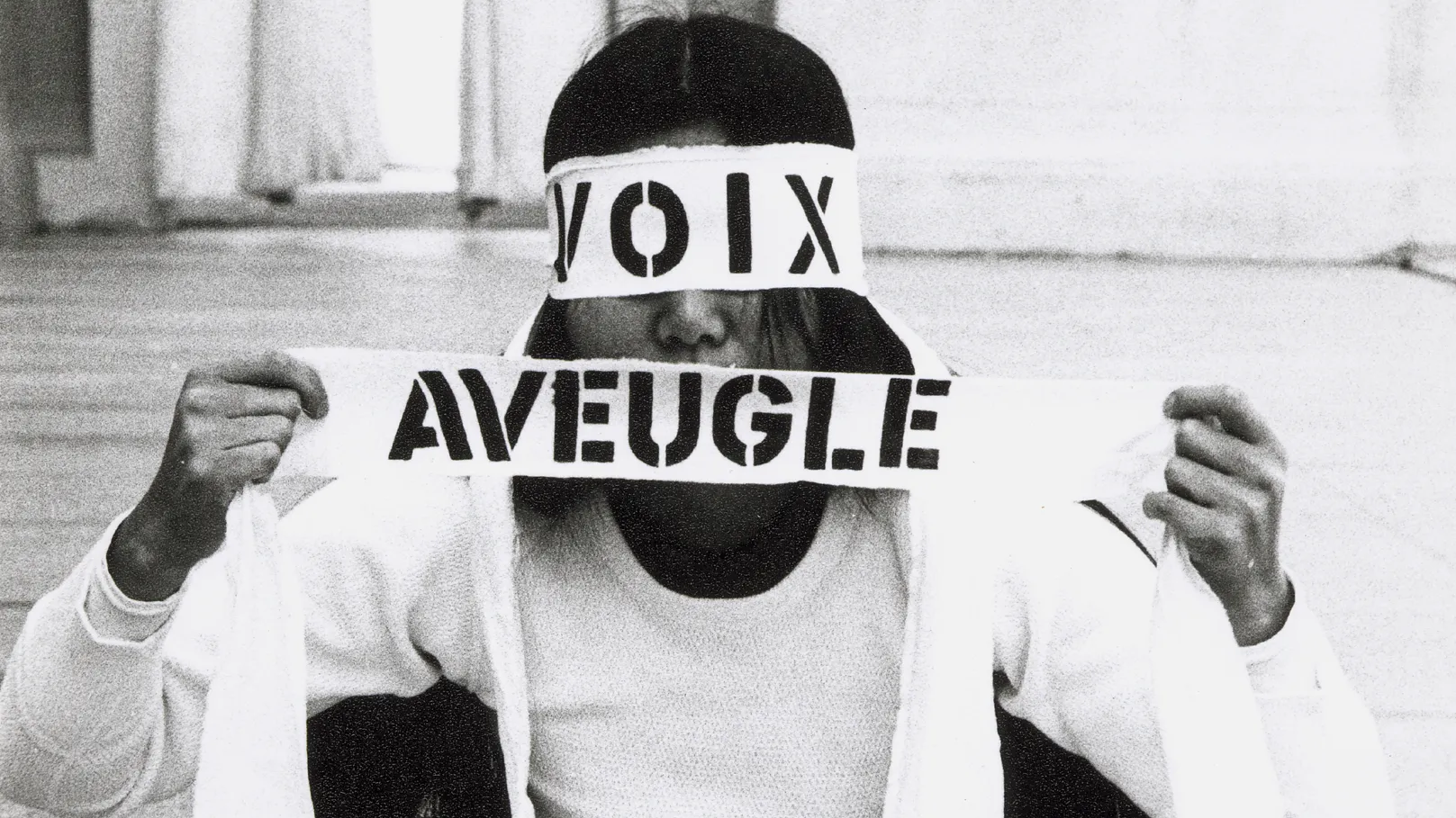
In pieces like Aveugle Voix (1975), Cha wrapped herself in white cloth stamped with words, blindfolding her eyes and mouth while unspooling banners that read “WORDS FAIL ME.” The performance turned her body into a site where language both hides and reveals. Watching the documentation today still feels electric.
Video and Film Experiments That Play with Time
Her films, such as Permutations (1976) and Mouth to Mouth (1975), use slow pans, repeated gestures, and overlaid sounds to mimic the slipperiness of memory. In one, Cha mouths Korean vowels silently to the camera; in another, her sister appears in flickering frames. These works slow you down and make you feel the gap between what’s seen and what’s said.
Mail Art and Concrete Poetry as Quiet Revolutions
Cha sent postcards and envelopes that flipped roles between sender and receiver, like Audience Distant Relative (1977–78). These small gestures turned the postal system into a space for dialogue across distance and time. They remind us that even everyday objects can carry profound questions about connection.
Early Ceramics and Fiber Works That Grounded Her Practice
Before the big conceptual leaps, Cha shaped clay pots and wove fibers from campus materials. These tactile pieces show her hands-on roots and a quiet confidence that everything—clay, thread, word—could become a vessel for deeper inquiry. They anchor the later, more ethereal works in something you can almost touch.
The Landmark Retrospective: Multiple Offerings at BAMPFA
Curated by Victoria Sung and Tausif Noor, this exhibition draws heavily from BAMPFA’s own archives—where Cha’s materials have lived since 1992—and adds loans from other artists. It fills the soaring galleries with documentation, projections, and objects that feel like a living conversation rather than a static display.
What Visitors Can Expect Inside the Galleries
Walk through chronologically and you’ll move from student experiments to Paris studies and late films. White scrims, old TVs, and hanging banners create an immersive flow. Sound leaks between rooms, and you might catch yourself pausing at a single typed envelope that suddenly feels monumental.
Key Works That Define the Show
Highlights include a reconstruction of Exilée (1980), Barren Cave Mute (1974) with its candle-lit revelations, and White Dust from Mongolia (1980), her unfinished film about returning to Korea. Together they trace how Cha kept circling back to themes of exile and return.
Curatorial Choices That Honor Cha’s Spirit
The curators deliberately blur boundaries and include works by peers and younger artists influenced by Cha. This approach mirrors her own open-ended practice and turns the show into a constellation rather than a solo spotlight.
Timeline of Cha’s Life and Career
| Year | Event | Key Work or Milestone |
|---|---|---|
| 1951 | Born in Busan, South Korea | — |
| 1963–64 | Family emigrates to U.S. | Early sense of displacement |
| 1970s | Studies at UC Berkeley | Ceramics, performances, Aveugle Voix |
| 1976 | Studies in Paris | Mouth to Mouth, Faire-Part |
| 1979–80 | First return to Korea | Exilée, White Dust from Mongolia |
| 1982 | Publishes Dictée; tragically murdered | Legacy begins |
This simple table captures how packed her decade was.
Themes That Run Through Every Piece
- Language as both barrier and bridge
- Memory’s fragmented nature
- Colonial and immigrant histories
- The body as a site of resistance
- Silence carrying as much weight as sound
These threads tie her entire output together without ever feeling repetitive.
Why This Retrospective Matters in 2026
Forty-four years after her death, Cha’s questions about identity and power feel freshly relevant. With ongoing conversations around diaspora, language justice, and violence against women, the show arrives at the perfect moment. It doesn’t just archive her work—it reactivates it.
How Cha’s Many Voices Influence Today’s Artists
Contemporary creators like Cecilia Vicuña, Renée Green, and Jesse Chun cite her directly. The exhibition includes their responses, showing how Cha’s refusal to simplify continues to open doors for new generations. Her influence ripples far beyond Asian American art circles.
Comparison: Cha Versus Other Pioneers of Diaspora Art
| Aspect | Theresa Hak Kyung Cha | Yoko Ono (example comparison) | Difference Highlight |
|---|---|---|---|
| Medium Focus | Text, video, performance hybrids | Performance, conceptual instructions | Cha integrates personal history more deeply |
| Language Approach | Multilingual glitches and silences | Wordplay and audience participation | Cha emphasizes colonial rupture |
| Legacy Impact | Cult status in literature and art | Mainstream pop-culture crossover | Cha remains more niche yet enduring |
Both artists broke forms, but Cha’s work carries a quieter, more layered ache tied to specific Korean histories.
Pros and Cons of Experiencing Cha’s Art Today
Pros
- Forces slow, attentive looking that rewards repeat visits
- Sparks genuine conversations about identity without easy answers
- Feels intimate despite its conceptual rigor
Cons
- Can feel demanding for first-time viewers expecting straightforward stories
- Some works exist only as documentation, losing live energy
- Themes of trauma may hit hard without preparation
Still, the pros far outweigh any hurdles. Her art meets you where you are and gently pulls you deeper.
People Also Ask About Theresa Hak Kyung Cha
Who was Theresa Hak Kyung Cha and why is she important?
She was a groundbreaking Korean-American artist whose work explored language, exile, and identity through multiple media. Her influence spans literature, film, and performance, making her essential for anyone interested in diaspora stories.
What is Dictée by Theresa Hak Kyung Cha about?
It’s an experimental book that weaves personal memory with Korean history, mythology, and colonial trauma. Think of it as a collage where voices from the past speak directly to the present.
What happened to Theresa Hak Kyung Cha?
She was raped and murdered in New York City in November 1982 at age 31, just days after Dictée came out. Her tragic death only amplified the power of the work she left behind.
Where can I see Theresa Hak Kyung Cha’s art right now?
Head to BAMPFA in Berkeley through April 19, 2026, or catch the show later at Artists Space in New York. Many pieces are also viewable online via museum archives.
How has Cha’s work shaped contemporary Asian American art?
It opened space for artists to reject linear narratives and embrace fragmentation. Writers like Cathy Park Hong and poets like Divya Victor continue the conversation she started.
FAQ: Common Questions Answered
Is the BAMPFA retrospective suitable for beginners?
Absolutely. The curators designed it with multiple entry points—visuals, sound, and text—so you can engage on your own terms. Guided tours help too.
Where can I buy or read Dictée today?
It’s widely available in print and ebook formats from major retailers. University presses often include it in Asian American studies reading lists.
Are there any upcoming events tied to the exhibition?
Yes—collective readings of Dictée, poetry workshops, and panel talks with scholars run through April. Check the BAMPFA calendar for dates.
Can I experience Cha’s films without visiting in person?
Some are digitized through Electronic Arts Intermix and museum sites, though the full installation context is best felt live.
What makes Multiple Offerings different from past Cha shows?
It’s the largest and most comprehensive yet, with unseen archival gems and a focus on her full career rather than Dictée alone.
Cha once wrote about “multiple telling with multiple offering.” This retrospective lives up to that promise, letting her voices multiply and echo long after the gallery lights dim. If you’re anywhere near the Bay Area before April 19, make the trip. Her art doesn’t just hang on walls—it asks you to listen, to remember, and to speak back in your own way. And if you can’t go in person, pick up Dictée or stream one of her films. Either way, you’ll walk away changed, carrying a little more of her many voices with you.
Author

johnliza828@gmail.com
Related Posts
At Lévy Gorvy Dayan, an Underrated Italian Master Gets His Biggest American Showcase in Decades
- 0
- 1,854 word
Who Was Domenico Gnoli? Domenico Gnoli was born in Rome in 1933 into a family steeped in art and culture. His mother...
Read out all
Anna Wintour, John Lithgow, and Nicholas Hytner Toast London’s Royal Court Theatre: Inside the Star-Studded New York Fundraiser
- 0
- 1,416 word
H2: A Glamorous Toast for a Theater IconJust last Sunday, New York’s theater crowd crossed the pond in spirit when Anna Wintour,...
Read out all